A strong reusable injection pen RFQ does not begin with color or packaging. It begins with the drug-container system, dose architecture, delivery performance, user needs, service life, materials, and evidence expected from the supplier. If those inputs are vague, quotations will look comparable while describing different devices, tests, and responsibilities.
The seven specifications below give procurement, device engineering, quality, regulatory, and commercial teams one shared framework. They are intentionally written to support supplier comparison and a qualified inquiry, not self-administration advice.
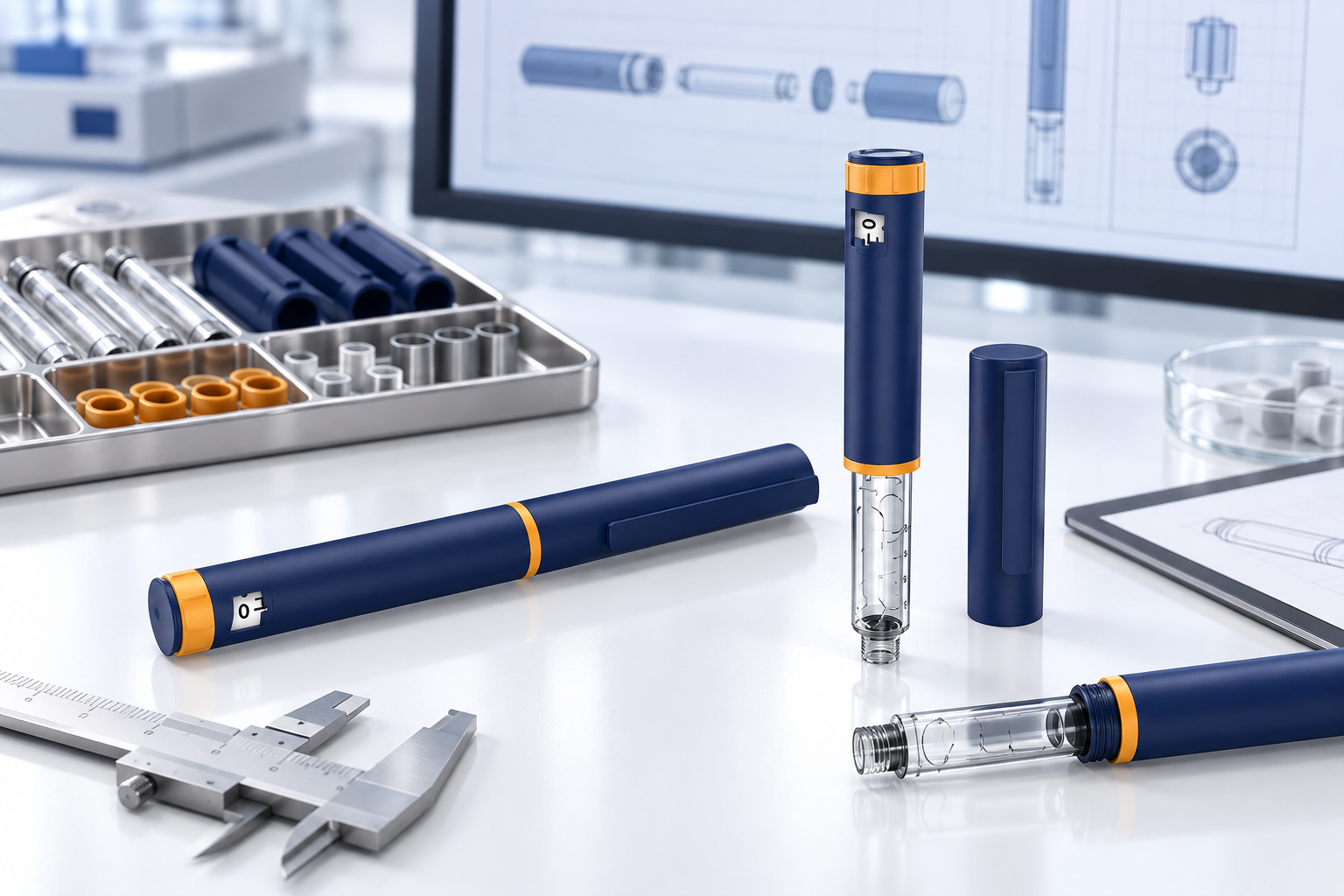
A complete reusable injection pen RFQ is a controlled requirement set that defines the container, dose, performance, user interface, lifecycle, customization, manufacturing, and evidence needed for a supplier response. Device-level requirements should be mapped to ISO 11608-1:2022, while container and fluid-path interfaces should be considered against ISO 11608-3:2022. Human factors planning should follow a risk-based process such as the one described in the FDA guidance on applying human factors and usability engineering to medical devices.
The RFQ should also state what is fixed and what remains open. If the cartridge and dose regimen are locked, provide drawings, tolerances, and representative samples. If the program is still selecting a container, ask the supplier to compare feasible platform combinations and identify which assumptions drive tooling, verification, and schedule.
Comparable RFQ specifications are measurable inputs that force every supplier to answer the same technical and commercial questions. Each requirement below should include a target, an acceptable range where appropriate, the evidence requested, and the party responsible for final-system confirmation.
Drug and cartridge compatibility is the demonstrated ability of the pen, cartridge, closure system, and fluid path to function together without unacceptable mechanical or material interaction. State the cartridge nominal volume, dimensional drawing and tolerances, stopper and plunger configuration, connection interface, fill range, storage orientation, temperature profile, and any sensitivity to silicone, adhesives, lubricants, or extractables. A common platform reference is a 3 mL cartridge, but nominal volume alone is not enough; flange, thread, stopper travel, and interface stack-up can change performance.
Dose architecture is the relationship between the smallest selectable increment, maximum selectable dose, total available doses, correction behavior, and handling of the final partial dose. Specify whether dosing is fixed, adjustable, or step-based; define the unit shown to the user; and require the supplier to explain how the device prevents an over-selection beyond the remaining contents. Wanhai's WH-RA public configurations use 3 mL cartridges with minimum increments from 0.005 mL to 0.0125 mL and maximum ranges from 0.08 mL to 0.8 mL, depending on the therapy and mechanism.
Delivered-dose accuracy is the agreement between the intended dose and the quantity delivered under defined operating and environmental conditions. The RFQ should request acceptance criteria, sample size rationale, beginning-middle-end cartridge coverage, orientation, temperature and humidity conditions, aging state, user force assumptions, and data reporting format. Ask which testing is platform evidence and which must be repeated with the final drug, cartridge, closure, and production-equivalent components.
Usability performance is the combination of forces, torques, displays, tactile cues, and audible feedback that enables the intended user to prepare and deliver a dose correctly. Define target user capabilities, maximum acceptable button force, dose-setting torque, display readability, correction behavior, priming workflow, and feedback at dose selection and delivery completion. Wanhai's WH-RA uses a large display window and audible and tactile feedback; those features should still be assessed with representative users in the final context of use.
Service life is the number of years, cartridges, or operating cycles for which the reusable device must continue to meet safety and performance requirements. State the expected use frequency, life in years, total cycles, transport conditions, drop scenarios, cleaning method, chemical exposure, storage temperature, and replacement strategy. The WH-RA platform publicly states a guaranteed pen lifetime of three years; a project should define the test profile and evidence needed to support the intended labeled life.
Material and finish requirements define the structural, chemical, visual, and tactile properties of every user-contacting and drug-adjacent component. Identify required polymer or metal preferences, restricted substances, surface finish, color targets, marking durability, cleaning compatibility, biocompatibility responsibilities, and brand-artwork controls. The WH-RA platform offers aluminum-alloy or plastic construction, metal or plastic cases, cylindrical or conical forms, and customizable scale, color, clip logo, case logo, and packaging graphics.
Manufacturing readiness is the supplier's demonstrated ability to reproduce the agreed design at forecast volume under controlled processes and documented change management. Ask for tooling ownership, critical-to-quality dimensions, mold-cavity strategy, process validation, inspection method capability, traceability, capacity calculations, approved-subcontractor controls, change-notification timing, complaint support, and the exact documents delivered at each development gate. Include forecast bands rather than one volume so the supplier can show the equipment and investment path from samples to launch.
An RFQ comparison table is a decision tool that links each specification to the supplier evidence needed to evaluate risk. Use the same table for every candidate and mark assumptions explicitly rather than accepting a generic confirmation.
RFQ field | Define in the request | Wanhai public platform reference | Risk if omitted |
Container | Drawing, nominal fill, closure, tolerances | 3 mL cartridge configurations | Interface failure or late redesign |
Dose architecture | Increment, maximum dose, correction, final dose | 0.005-0.0125 mL increments; ranges to 0.8 mL by configuration | Non-comparable mechanisms |
Accuracy | Acceptance criteria, test states, sample plan | Project-specific confirmation required | Insufficient verification evidence |
User forces | Button force, torque, display and feedback | Large window plus audible and tactile cues | Use errors or poor acceptance |
Service life | Years, cycles, drops, cleaning and aging | Three-year stated platform life | Durability gap after launch |
Materials and brand | Materials, finish, colors, marks, cases | Metal or plastic options and customizable appearance | Artwork or compatibility rework |
Industrialization | Tooling, validation, yield, capacity, change control | Integrated development and manufacturing support | Schedule and supply instability |
Specification priority is the ranking of requirements according to the clinical use pattern, commercial model, and technical risk of a particular drug program. For a daily chronic-therapy device, service life, cartridge change, readability, cleaning, and repeated user handling may dominate. For a lower-frequency therapy, intuitive restart after long intervals, clear feedback, and training burden can carry more weight. For a high-dose or high-viscosity formulation, force, delivery time, structural margin, and container interfaces become central.
Procurement should not assign priorities alone. A short cross-functional workshop can classify each requirement as critical, important, or desirable and identify the verification owner. This prevents a visually attractive platform from advancing while dose accuracy, service life, or primary-container compatibility remains unresolved.
A reusable pen development partner supports platform selection, configuration, customization, industrialization, and documentation as connected workstreams. Wanhai Medical's reusable injection pen portfolio provides the commercial landing point, while the WH-RA reusable pen injector shows 3 mL cartridge configurations across multiple dose architectures. Its customization capabilities cover scale markings, color, logos, form factors, material choices, cases, and packaging.
The fastest first response comes from a complete requirement pack. Share the cartridge drawing, target fill, dose regimen, expected user population, launch countries, annual forecast, desired life, brand direction, and evidence expectations. Wanhai can then identify the closest platform and separate standard features from project-specific engineering and verification.
Ready to turn the seven fields into a project RFQ? Send your reusable pen requirements to Wanhai Medical |
A high-converting reusable injection pen RFQ is one that converts product intent into measurable supplier commitments. Define cartridge compatibility, dose architecture, accuracy, user forces and feedback, service life, materials and customization, and manufacturing evidence before comparing quotations. This approach reduces hidden assumptions, improves cross-functional review, and directs qualified commercial traffic toward a concrete configuration discussion with Wanhai Medical.
These frequently asked questions answer the specification and sourcing issues most often raised during reusable injection pen evaluation.
Provide the cartridge drawing and volume, closure configuration, dose increment and range, target user group, representative formulation properties, service-life expectation, target markets, and preferred materials. Without those inputs, a sample may demonstrate appearance but not program fit.
No. Nominal volume is only one attribute. Dimensional tolerances, stopper geometry, plunger travel, connection features, break-loose and glide behavior, materials, and assembly stack-up can all affect performance. Final compatibility must be demonstrated with the intended system.
State the dose points, acceptance criteria, beginning-middle-end cartridge conditions, sample plan, environmental states, aging condition, orientation, and reporting method. Ask the supplier to identify which data already exist and which tests require the final drug-container configuration.
The required life should come from the treatment pattern and replacement strategy, expressed in both years and expected operating cycles. It should include storage, transport, drops, cleaning, environmental exposure, and margin. Wanhai's WH-RA states a three-year platform life, subject to project-specific confirmation.
Changes to mechanism geometry, dose scale, materials, surface finish, user-contact features, or container interfaces can affect performance and evidence. Color and artwork may be lower risk, but pigment, marking durability, and manufacturing processes still require controlled review.
Include company and project context, formulation and container information, dose concept, launch markets, volume forecast, schedule, customization needs, and the technical documents you expect. That enables the team to recommend a platform and outline next steps without an extended discovery loop.

Hey, I'm Mike, a R&D engineer at Wanhai Medical, and I work with injection pens every day.
In the past decade, we have provided products and integrated services to over 180 renowned pharmaceutical companies, serving clients across more than 60 countries and territories worldwide.
My days are a "battle for details". This job's meaning is in countless "gentle moments". It turns cold medical processes into warm help, easing long-term injectors' fear and boosting their confidence. Behind it all is my social responsibility, rooted in professionalism and passion: "to make sure every user is well cared for."

 中文
中文
 English
 français
 Español
 العربية
 русский